


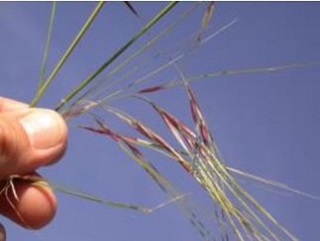
 Chilean Needle Grass is a highly invasive perennial weed that is a serious pasture and environmental weed in many parts of the Northern Tablelands region. It grows in dense tussocks and has the potential to rapidly colonise both agricultural land and natural ecosystems. Its relative unpalatability, persistent seedbank and ability to grow on bare ground gives it the potential to rapidly displace more desirable pasture species. The panicle seed readily attaches to stock and native animals and can cause injury by burrowing into the skin and muscle. It may also downgrade wool and affect meat quality. Heavy infestations can reduce farm productivity by as much as 50% during summer.
Image source: NSW DPI
Identification
Chilean needle grass grows to approximately 1m high. It is very similar in appearance to native spear grasses (Austrostipa spp.), tall fescue and wallaby grasses (Austrodanthonia spp.), but has a prominent crown-like corona and a raised crown of hairs at the junction of the seed body and awn. Seed heads emerge in spring to late summer and have a distinctive purplish colour.
How is it spread.
Chilean needle grass is a prolific seeder and can produce more than 20,000 seeds per square metre. Seeds are also produced at the nodes of flowering stems and this accounts for approximately 25% of the overall seed the plant produces. Animal movements, contaminated fodder, vehicles and machinery all have the potential to introduce or spread Chilean needle grass seeds. Seeds can also spread along drainage lines or floodwaters. It is less common for Chilean needle grass to be dispersed by the wind.
Control
The persistent seed bank makes Chilean needle grass difficult to control and a long-term integrated program that combines herbicide application with physical remove, crop rotation, pasture sowing, and grazing management (short duration, high intensity) will need to be considered. Preventing new areas of infestation is also critical. More information on control of Chilean needle grass and details of registered herbicide application rates are available through NSW Weedwise and your Local Council or Weeds Authority.
In NSW, all Chilean needle grass plants are regulated with a general biosecurity duty to prevent, eliminate or minimise any biosecurity risk they may pose. Any person who deals with any plant, who knows (or ought to know) of any biosecurity risk has a duty to ensure the risk is prevented, eliminated or minimised, so far as it is reasonably applicable.
In the Northern Tablelands, Chilean needle grass has a Priority Weeds Objective of Asset protection within the whole region. The Regional Recommended Measure is: ‘Land managers should prevent spread from their land where feasible. Land managers should mitigate the risk of new weeds being introduced to their land. The plant should not be bought, sold, grown, carried or released into the environment. Mandatory measure (Division 8, Clause 33 Biosecurity Regulation 2017) A person must not import into the state or sell.’
More information, including details of how to control Chilean needle grass on your property, is available on NSW WeedWise or through your local Weeds Authority, including NEWA.
Focus On Weeds - Chilean Needle Grass
Northern Tablelands Local Land Services: Ag Update - June 2021