


 A new Eucalyptus species has been described from sacred bushland on Kamilaroi country on the Northern Tablelands of NSW, with only 1000 of the plants estimated to exist in the wild.
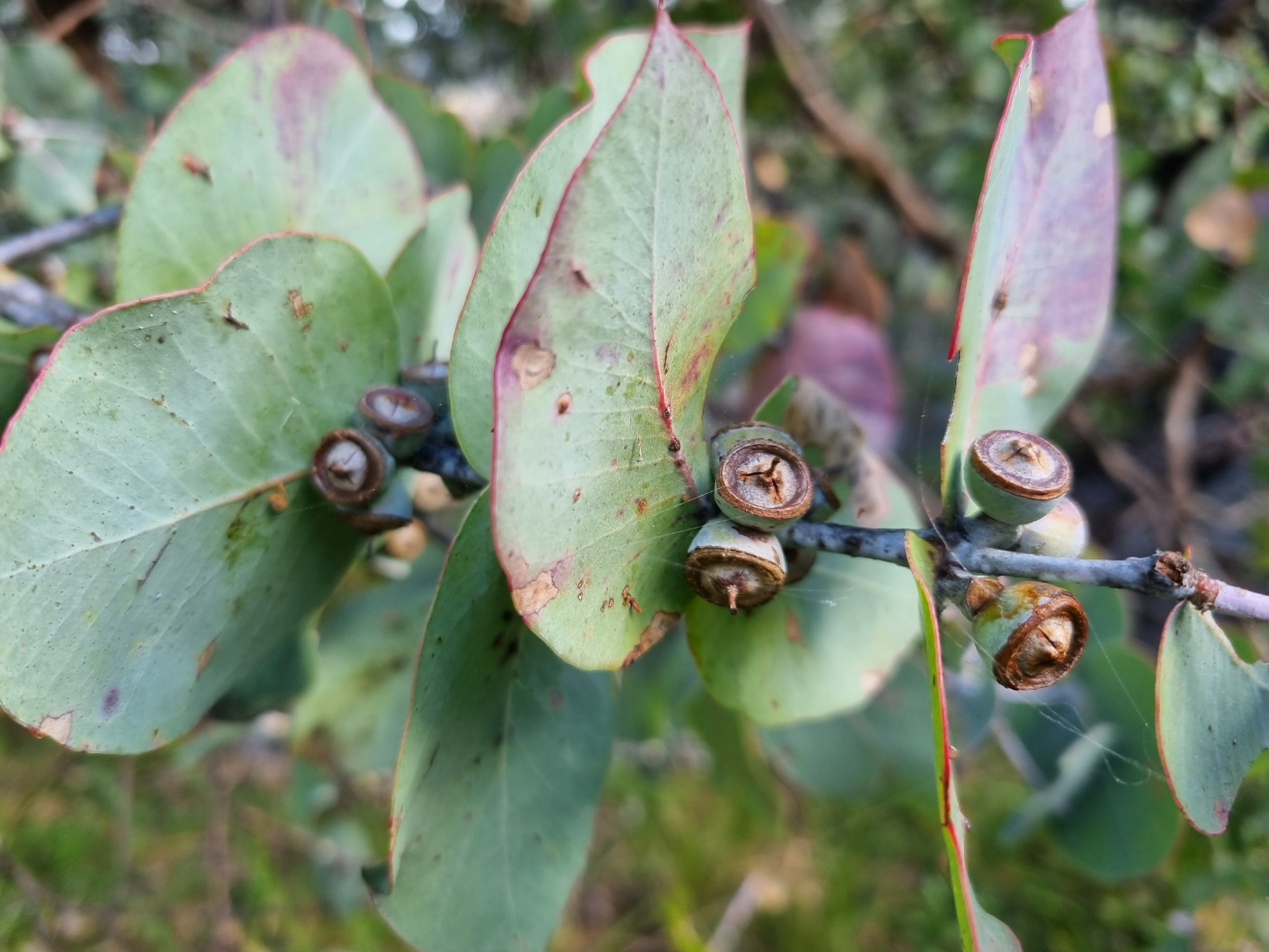
Eucalyptus bunawanjan features striking, pale grey-green foliage with rounded, waxy leaves, and its recognition will shape future conservation practices in the area and highlights the potential for further unknown species to be identified.
The discovery occurred when adjunct University of New England (UNE) ecologists Dr Michelle McKemey and Professor John Hunter were conducting plant surveys on a Mooki & Bassendean Association Inc (MABAI) property near Tingha, NSW, as part of a project funded by the Northern Tablelands Local Land Services.
Because the trees were growing in an area with cultural restrictions, a specific female-led team was enlisted to investigate further.
Dr McKemey, who has worked alongside local Traditional Owners for more than a decade, was joined by Banbai ranger Aunty Lesley Patterson, UNE Associate Professor Rose Andrew, and Master’s student Claire Hewitt to determine if the species was new to western science.
“Closer examination and DNA analysis of the population confirmed that it was distinct and required a formal taxonomic description,” says A/Prof Andrew, a conservation geneticist within the UNE Botany team.
The Traditional Owners gave permission for the species to be named Bunawanjan after the landform on which it was found, and have advised that the area it’s located will be managed by local Aboriginal women who have connection to Country as per Traditional Law.
Associate Professor Rose Andrew (left) takes samples from a new species of eucalypt, watched by Kamilaroi elder Aunty Lesley Patterson and master’s student Claire Hewitt.
Image: Associate Professor Rose Andrew (left) takes samples from a new species of eucalypt, watched by Kamilaroi elder Aunty Lesley Patterson and master’s student Claire Hewitt.
Another significant feature of Eucalyptus bunawanjan is a distinctive trait known as 'neoteny', where juvenile characteristics are retained into adulthood.
“In most eucalypts, juvenile leaves are very different from adult leaves, and flowering typically only occurs on branches with adult foliage,” A/Prof Andrew says.
“However, Eucalyptus bunawanjan maintains juvenile foliage over most of the tree and produces flowers in small clusters amongst those rounded leaves.”
Additional expertise was provided by Adjunct Prof John Hunter, Dr Andrew Thornhill, Director of the UNE N.C.W. Beadle Herbarium, and Dr Patrick Fahey from the Queensland Herbarium.
Vouchered specimens are now housed in the Beadle Herbarium at the UNE Armidale Campus, with extras sent to other herbaria around Australia and the world for further study.
Meanwhile, work will continue with Traditional Owners to formally assess the conservation status of the species.
“Now that it has been documented, the presence of this unique species can be factored into land management and conservation decisions,” A/Prof Andrew says.
“It also highlights that gaps in botanical knowledge still exist. There is a lot still to be learned about this species, and likely more unrecognised species waiting for attention.”
The species has been formally described and published in Telopea here.